Product Description
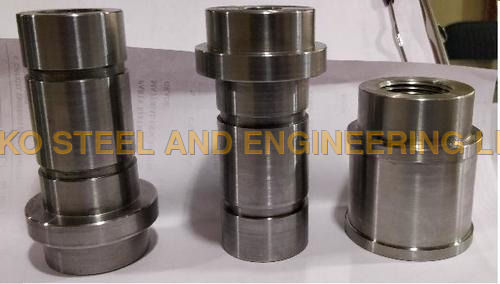
Stainless Steel Forgings offered by us have been extensively utilized as replacement of damaged parts of industrial machines and while construction of new ones. They are made of excellent grade steel alloy using forging technology so as to ensure superior structural strength and high durability. These forgings are designed using CNC machines for ensuring great dimensional & structural precision. They are available in customized configurations as requested by our clients at reasonable rates. SS Forgings provided by us have galvanized surface finish which provides good protection against corrosion.
Heat-Treated for Superior PerformanceThese stainless steel forgings undergo expert heat treatments such as annealing, quenching & tempering, and normalizing. This process enhances mechanical strength, toughness, and machinability, ensuring components can withstand high pressures (up to 2500 psi) and a wide temperature range from -40C to 600C.
Precision Forging and Rigorous TestingManufactured using open die, closed die, and ring rolling techniques, these components maintain tight tolerances (0.01 mm) and versatile shapes. Each product is thoroughly inspected via ultrasonic, magnetic particle, dye penetrant, and visual testing for dependable quality and performance.
Versatile Applications Across IndustriesEngineered for reliability, these stainless steel forgings serve key roles in industries such as automobile, oil & gas, chemical, marine, and power generation. With excellent corrosion resistance, high strength, and a selection of connection types, they are ideal for critical and high-performance environments.
FAQ's of Stainless Steel Forgings:
Q: How are stainless steel forgings manufactured and what processes are used?
A: Stainless steel forgings are produced using processes like open die forging, closed die forging, and ring rolling. These techniques shape the steel into various forms such as flanges, rings, discs, and shafts, delivering high structural integrity and precise tolerances.
Q: What types of heat treatment are applied to these forgings, and why?
A: Forgings are heat treated through methods like annealing, quenching & tempering, and normalizing. These treatments improve machinability, promote uniform hardness (170-250 HB), and enhance mechanical strength and durability for demanding industrial applications.
Q: When is it beneficial to use stainless steel forgings in industrial settings?
A: Stainless steel forgings are ideal for use when high corrosion resistance, mechanical strength, and precise tolerances are crucial-such as in chemical plants, petrochemical facilities, marine environments, and heavy machinery manufacturing.
Q: What testing methods ensure the quality of these stainless steel forgings?
A: Quality is ensured by rigorous testing-ultrasonic, magnetic particle, dye penetrant, and visual inspections-to detect internal flaws, surface cracks, and dimensional accuracy, guaranteeing reliability and safety of every component.
Q: Where can stainless steel forgings be applied, considering their properties?
A: Due to their excellent corrosion resistance and high strength, these forgings are used in automotive, oil & gas, chemical, marine, construction, and power generation sectors, serving as crucial components in various machinery and assemblies.
Q: What connection and sealing types are available with these forgings?
A: These forgings offer welded, threaded (BSP, NPT, Metric), socket weld, and butt weld connections. The sealing type is typically metal-to-metal, ensuring robust and leak-proof performance in high-pressure environments.






 Send Inquiry


 Send Inquiry
 Send SMS
 Call Me Free


